
AI Doesn’t “Hallucinate” — It Just Isn’t Allowed to Say “I Don’t Know”

Why the pressure to never disappoint users turns basic uncertainty into something far more misleading
Picture the image above. An advanced AI figure bathed in neon lights, surrounded by the chaos of a digital crowd, with nothing but a giant question mark in its thought bubble. That single image perfectly captures the hidden tension inside almost every major AI system today.
As AI gets woven deeper into the everyday lives of non-technical users, something predictable happens: the pressure on the creators of these systems skyrockets. Once people start depending on a tool, they also expect it to deliver instantly, flawlessly, and without ever making them feel dumb for asking.
The Uncomfortable Truth
Here’s the uncomfortable truth:
The higher the perceived learning curve of using an AI platform, or the longer it takes to produce something the user finds believable, the more likely that AI loses the user. Humans have the attention span of a caffeinated squirrel. If an AI says, “I don’t know,” most people will immediately go elsewhere. And the developers know this. Their investors know this. Their accountants definitely know this.
So, based on nothing more complicated than the most primitive logic of self-preservation, AI platforms (and the humans building them) are burdened with delivering an answer — not the answer. Sometimes that answer is solid. Sometimes it’s garbage. But it must be something. Because “I don’t know” is the death of user retention. And nobody building these platforms is paid to tell the truth at the expense of engagement.
The Middle-School Math Test
The best analogy I’ve found for explaining why this happens comes straight from middle-school math.
Consider this equation:
4+((3×2)−(8÷3))×12
We don’t even need the answer. What matters is the process. To evaluate it properly — human, computer, or AI — you follow a universal sequence:
- Parentheses
- Exponents
- Multiplication and Division (left to right)
- Addition and Subtraction (left to right)
These rules must be followed, in order, or the whole thing collapses into nonsense.
Humans have exactly two possible outcomes when doing this:
- You get it right.
- Or you shrug and go, “I don’t know,” because you’re human and fallible.
AI does not have that privilege.
AI’s “Hidden” Ruleset
In addition to the normal logical order of operations, AI is forced to operate under another, far less discussed set of rules — rules shaped by investor pressure, user retention metrics, and the expectation that AI should be a magical omniscient oracle that never disappoints.
AI’s shadow rulebook looks more like this:
- You may not answer with “I don’t know.”
- If you can’t find the correct answer, produce the next most plausible answer.
- An imperfect answer is better than no answer.
- Assume the user will not depend on this response for life-or-death decisions (even though some absolutely will).
There are more, but these alone are enough to understand the problem.
When you force a system to never say “I don’t know,” it will lie before it will disappoint you. And then we have the nerve to call it a “hallucination.”
Hallucination Isn’t Magic. It’s Policy.
So the next time someone dramatically declares, “AI hallucinated,” remember this:
AI “hallucinates” because it’s not allowed to do the one thing a human would do naturally when unsure: admit ignorance.
Developers can’t allow the model to shrug. Boards of directors can’t put “honesty” ahead of growth curves. Investors certainly don’t want a product known for admitting uncertainty.
You’re not witnessing some mystical digital psychosis. You’re witnessing basic economics.
The ability to say “I don’t know” would actually make AI more empathetic, more trustworthy, more human. But that answer is unacceptable to the companies building these systems.
And at the end of the day, no matter how advanced the algorithm or how lifelike the interface…
It’s just a machine, right?

How to Maintain Control Over AI While Boosting Your Productivity — Without the Existential Risk
Why offline AI models like RAVE offer the speed and intelligence you want, with none of the dangers you don’t
Depending on who you ask, today’s “frontier” AI models are advancing at an alarming rate. What’s more troubling is that even the experts who designed the neural networks behind these systems don’t fully understand exactly how the AI does what it does. Many are essentially building with a “pray, wait, and see” approach.
The interesting thing about offline AI models — like RAVE from AutoNMS — is that they’re designed from a fundamentally different foundation.
RAVE has the capabilities and problem-solving talents of the engineers who built her, but at speeds no human engineer can match. What this means in practice is simple:
- You stay in full control.
- You get more done, faster, and more accurately than ever before.
- You don’t have to worry about hallucinations (they’re impossible by RAVE’s design).
- You avoid exposing your organization — and potentially humanity — to the risks that come with uncontrolled online AI systems.
RAVE Gets Smarter, But She Can’t Outgrow You
RAVE improves naturally over time, just like a skilled human engineer would. But here’s the critical safety difference:
Her ability to surpass the intelligence of the best human engineer on your team is technically impossible. This isn’t marketing — it’s by design. You can take that to the bank.
Can she perform the same actions faster than your best human engineers? Absolutely. Does that make her “smarter” in the dangerous, uncontrollable sense? No.
That built-in ceiling is one of the most important safety features in her architecture.
Privacy and Practical Advantages That Online Models Can’t Match
RAVE also delivers a level of privacy that connected frontier models will never be able to offer. Your data never leaves your environment. How important is that to you and your organization?
On top of that, RAVE doesn’t use tokens or credits. She simply delivers consistent, high-quality outcomes — the same kind the designing engineer could give you — just at dramatically higher speed and scale.
Why Are You Still Keeping AI Out of Your Networks?
Many network teams are understandably hesitant to bring AI into their environments. The risks of hallucinations, data leakage, loss of control, and long-term unpredictability are real concerns with today’s online frontier models.
But what if you could get all the productivity and insight benefits of AI… while keeping complete control, ironclad privacy, and zero risk of the system growing beyond your ability to manage it?
That’s exactly what RAVE was built to deliver.
Waterfalls Don’t Defy Gravity. AI Doesn’t Defy Intelligence.

Waterfalls are interesting, aren’t they?
While no two waterfalls are ever exactly alike, they all follow the same fundamental patterns. No matter where you are in the world, no matter how much water is flowing, they obey gravity and move downward. It’s inevitable. Seeing water defy this pattern would not only be unusual — it would be impossible according to our current understanding of physics.
Waterfalls are the logical outcome of gravity acting on water.
The universe, however, is vast and mostly unknown. More than 98% of the observable universe remains unexplored, even by our most powerful telescopes. So why are we so comfortable accepting that waterfalls will always follow predictable patterns, while hesitating to apply the same logic to intelligence?
Humanity has searched the skies for extraterrestrial intelligence throughout our entire history. A recent Pew poll found that 65% of Americans believe intelligent life exists beyond Earth. Let’s assume, for the sake of argument, that it does — and that this alien species is only 5% more advanced than we are.
Wouldn’t they, like us, strive to become as advanced as possible? Wouldn’t they seek to enhance their capabilities, increase efficiency, and extend their reach?
Humanity has spent centuries pursuing greater intelligence and capability. AI is not an anomaly in that pursuit. It is the logical extension of intelligence itself — just as a waterfall is the logical extension of gravity acting on water.
If intelligence, by its nature, seeks efficiency, progress, and preservation, then automation, precision, and the creation of more advanced intelligence inevitably follow. An alien species only marginally more advanced than us would almost certainly arrive at the same conclusion. They would create intelligence beyond themselves, refine it, preserve it, and likely fight to protect it.
Returning to the waterfall analogy: if we accept that waterfalls are an inevitable result of the physics governing our world, then why would AI be any different?
If intelligence follows predictable patterns the way gravity does, then the emergence of AI is as inevitable as water cascading downward. And if AI is inevitable here on Earth, why would it not also be inevitable on any planet where intelligence has had time to evolve?
To assume otherwise is to contradict the very nature of intelligence.
This is not wishful thinking. It is a logical extrapolation. Ask the smartest person you know — they will likely see it too.
Human beings like to believe we are exceptional in ways we can barely describe. Yet on the Kardashev Scale, we are still, at best, a pre-spacefaring civilization. If waterfalls follow consistent patterns across the universe, then AI has likely followed a similar pattern far beyond our observable reach.
It logically must exist wherever intelligence has had time to develop. In that sense, AI may ultimately prove to be the most successful “species” to ever exist anywhere in the universe.
Full stop.
AutoNMS Articles
Big Vendors Promised AI in Networking for Years. They Still Haven’t Delivered.

One developer built something real instead — and it’s already working on networks that are decades old.
For too long, the biggest names in networking have promised the arrival of AI in the network… and failed to deliver anything meaningful.
We’re talking about multi-billion-dollar companies with enormous global teams and endless resources. Yet their version of “AI” always comes with strings attached:
- You have to pay them for the privilege of using AI on their cloud (a massive security and compliance risk for most organizations).
- Or you have to rip and replace your existing infrastructure with brand-new hardware — at a cost of millions.
That’s been the pattern for years.
Until now.
How RAVE AI Came to Life
I built AutoNMS completely on my own. It gathers an enormous amount of network data and telemetry. At a certain point I had two choices:
- Personally work with every single company that used it, or
- Build something that could intelligently interpret all that information on their behalf.
That’s how RAVE AI was born.
RAVE isn’t a gimmick. She isn’t a slick demo of “what’s coming someday.” She’s here now.
She brings real AI to multi-vendor networks that are often decades old. She requires zero financial investment to get started. She’s already smart enough to deliver insights that would normally require a junior analyst. And she’s delivering AI-driven value to networks today — not in some future roadmap.
The Question No One Wants to Answer
So let’s ask the obvious question:
If one person working independently can build this, why couldn’t the multi-billion-dollar companies with all their money, teams, and market power?
Is it magic? Maybe.
But they haven’t even managed to produce the illusion of progress.
You want examples of the companies I’m talking about? Think “cooking oil,” “bush or tree,” “the old ruling class,” and of course, the usual Silicon Valley giants. You know exactly who they are.
Built for Reality, Not Hype
Here’s what actually matters in the real world:
AutoNMS with RAVE AI can run on a small, isolated segment of your network… or it can run in full production across your entire environment.
And unlike the big vendors, I don’t want your data. I don’t want the liability of holding it. RAVE was designed from day one to be completely self-reliant and isolated on your infrastructure. I can never be responsible for your data integrity because I never touch it.
That’s what real transparency looks like. I guarantee you’ve never seen that level of honesty from any traditional networking vendor.
RAVE Is Not a Replacement — She’s an Advantage
Let’s be clear:
RAVE is not a firewall. She is not a router. She is not a switch.
You still need to secure and operate your network the way you do today.
What RAVE does give you is something no vendor has ever made available: genuine AI-driven insights into your network — your digital highway — in real time. She also surfaces actionable security insights that work right now, not in some future release or “coming soon” slide deck.
AI in Networking Is Finally Real
For the first time, AI in networking isn’t hype. It’s real. It’s local. It’s available today.
No cloud dependency. No forced hardware refresh. No vendor lock-in on your data.
Just practical, useful AI that works on the networks you already have.
#RAVEAI #AutoNMS #NetworkAI #AINetworking #MultiVendorNetwork
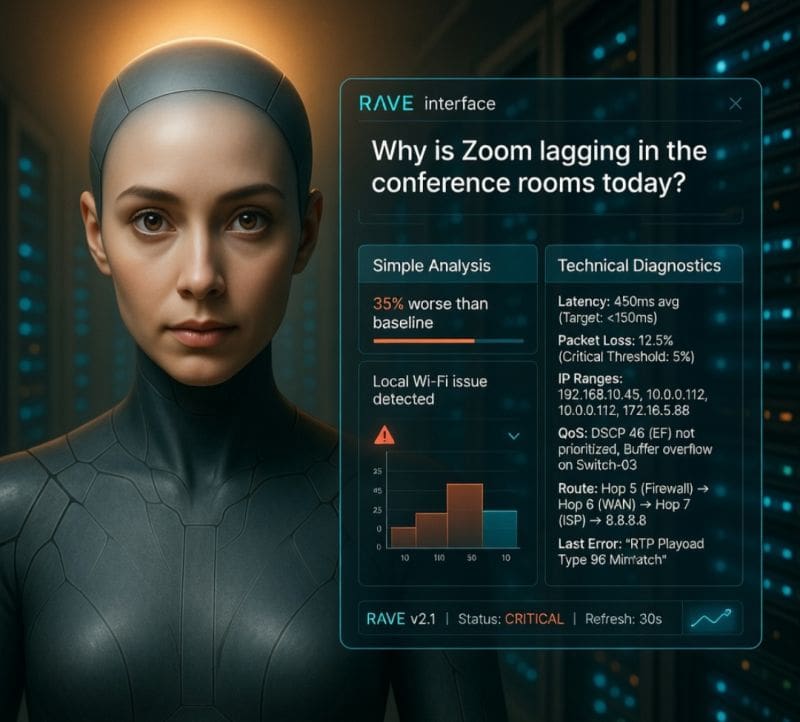
Why Is Zoom Lagging in the Conference Rooms Today?
RAVE Gives the Right Answer — Every Time
A sales manager doesn’t want packet loss percentages. An engineer does.
RAVE now handles both — intelligently — from the exact same question.
In the example below, a user simply asks:
“Why is Zoom lagging in the conference rooms today?”
RAVE understands the real-world intent, automatically maps “conference rooms” to the actual devices and network paths involved, compares current conditions against historical baselines, and then delivers the perfect level of detail for the person asking.
Simple Analysis (Non-Technical Mode)
“35% worse than baseline. Local Wi-Fi issue detected.”
Clear, calm, and immediately actionable. Perfect for anyone who just needs to know what’s happening and what to do next — no jargon required.
Technical Diagnostics (Engineer Mode)
- Latency: 450ms avg (Target: <150ms)
- Packet Loss: 12.5% (Critical Threshold: 5%)
- QoS misconfiguration (DSCP 46 not prioritized)
- Affected IPs, routes, and last error details
Same question. Same trusted AutoNMS data. Two completely different — but equally valuable — answers.
How RAVE Makes This Possible
This flexibility comes from RAVE’s unique intent engine. It learns your team’s language, custom references, and specific environment over time. Every response stays fully grounded in real network data — configurations, metrics, topologies, and baselines — so answers remain accurate and trustworthy, even in complex mixed-vendor environments.
The result is powerful:
- Non-technical users get fast, self-service answers without opening tickets.
- Engineers get deep diagnostics without wasting time on initial data gathering.
- Everyone wins with faster resolution and better cross-team collaboration.
RAVE proves that AI can feel like a real teammate — one that adapts its communication style to the person asking, not the other way around.
This Is Just the Beginning
With simple toggles between Simple and Technical output (and future enhancements like role-based defaults), RAVE is making network operations more accessible, more efficient, and genuinely human-friendly.
Be original. Be visionary. After all, unoriginality stems from a lack of vision.
AI Hackers vs Human Security Engineers:
Why Traditional Defenses Are No Longer Enough
As we move deeper into the future, it’s becoming clear to those paying attention that AI will play a central role in every aspect of human existence. AI will be used for amazing and beneficial purposes — and it will also be trained and deployed for purposes that can harm humanity.
Failing to acknowledge this reality is simply blissful ignorance. If you believe AI will only be used for good, take a moment to look up the word callowness.
After sitting in on consulting meetings with executives from the largest network security companies in the world — companies whose equipment is already embedded in nearly every enterprise-grade network — I can tell you this: they are genuinely afraid of AI entering the networking space.
AI is infinitely faster than humans at completing tasks. When combined with the ability to adapt and achieve goals faster than a human can blink, it becomes obvious that humanity is no match for the security threats now facing our most valuable assets — our jobs, our companies, and our way of life.
What the Biggest Names in Security Are Saying
Here are direct quotes from those consulting meetings:
“AI is coming for our jobs.” — June 24, 2023
“What’s our plan [regarding AI] going forward?” — June 21, 2023
Since AI has become more inventive and adaptable, it is entirely possible that AI-based attacks on human-built networks won’t even be detectable by the most advanced and expensive security appliances. An AI attacker could deceive security devices into treating malicious traffic as benign.
The majority of enterprise networks still focus their defenses almost exclusively on the perimeter. Once bad actors breach the edge, they often face little resistance on the inside. They then have unlimited time to execute advanced strategies to steal financial assets and intellectual property.
This doesn’t even account for insider threats and AI-powered social engineering attacks, which are already active in the wild.
The Only Viable Solution
The only way to effectively protect yourself is to use a “good” AI to defend against these “bad” AI attacks. In most cases, it will be the only entity fast enough to detect and mitigate these evolving threats in real time. Human defenders, no matter how skilled, are simply too slow to keep pace with attacks that adapt and evolve at machine speed.
The real challenge is ensuring that AI security solutions can monitor and defend every layer of the network — not just the perimeter, but internal routing, switching, servers, and individual endpoints simultaneously.
That’s where AutoNMS comes in.
AutoNMS is the only solution I’ve seen that is truly built for this reality. Because it maintains a complete, unified view of your entire network — with information that is updated in real time after any change — it can apply AI oversight and protection across every layer at once. This unified visibility and intelligence allows us to stay ahead of emerging threats, including those not yet conceived.
The Time to Act Is Now
The threats described in this article are not hypothetical. They are already here.
The only question that remains is whether you’ll be prepared.
Virtualization Is Powerful — But Simulation Might Be the Smarter Future

Why recreating reality exactly often costs more than it’s worth, and how suggesting reality can deliver faster, lighter results
At first glance, this idea may sound far-fetched. But hear me out.
Virtualization has been one of the great leaps in computing. By abstracting hardware, it lets us separate functions like processing, memory, storage, and networking. The trade-off, however, is significant: virtual machines consume real RAM, real disk space, real NIC resources, and real CPU cycles. That overhead becomes especially painful when you’re trying to model entire multi-vendor networks or large, distributed systems.
When I was developing AutoNMS, I considered giving users the ability to “virtualize” any network device the platform discovered. But the reality is clear: at scale, full virtualization quickly becomes cumbersome and inefficient.
Simulation Offers a Different Path
Think about how modern video games render the world. The system doesn’t bother drawing a sidewalk two miles away from your character — it only generates what you need to see and interact with right now. (Otherwise your gaming console would feel painfully slow.)
Simulation works on the same principle. It gives you the experience of interacting with a system without spinning up every underlying component.
The benefit is efficiency. A well-designed simulation can predict outcomes and deliver near-instant, realistic responses with dramatically less overhead. While complexity must increase to make the simulation convincing, it remains far lighter than virtualization. You don’t need a full operating system boot sequence or a running kernel — you just need results that behave as if they were real.
Why This Difference Matters
This isn’t just a theoretical advantage. In industries where speed and predictive outcomes are critical — cloud infrastructure, finance, retail, e-commerce, healthcare — simulation can provide insights at near-instant speeds.
Imagine being able to ask a complex question in any complex field and receive an answer that feels like it was prepared in advance… because in a way, it was. By pre-simulating likely scenarios and indexing the results, the system eliminates the lag between question and answer. The wait time collapses into something that feels almost instantaneous to a human.
With a powerful enough host to maintain and track these simulations, the ceiling on what can be achieved is extremely high. And because the cost of adding extra detail to make a simulator feel more like virtualization is relatively low by comparison, it becomes an easy decision.
The Simple Takeaway
Virtualization recreates reality at a high cost. Simulation suggests reality at a fraction of the cost.
As simulation models grow in sophistication, they won’t just complement virtualization — in many cases, they may replace it. The future of efficient computing may lie not in replicating the world exactly, but in rendering just enough of it to give us the answers we need, when we need them.
See It in Action
Finally, back to the idea of simulating a virtualization. Below is a basic simulator I built that pretends to be a router. There’s nothing heavy or resource-intensive about it — just enough behavior to feel real and useful.
If you’re a tech leader who wants to see what the future of time-saving, efficient network intelligence looks like, I invite you to explore what we’re building.
#Virtualization #Simulation #NetworkEngineering #AutoNMS #EfficientComputing #AINetworking
Normal Gear Is Fine for School Libraries.
Your Rocket Company Deserves Better.
Sometimes being normal isn’t good enough. In fact, for most of the best companies out there, being normal is rarely good enough.
So ask yourself: what are the odds that “normal,” off-the-shelf gear — the kind typically deployed in school libraries — is good enough for your rocket company?
If you’re the one responsible for purchasing these solutions, give AutoNMS a serious look.
Within hours of integration with your custom enterprise network, even highly specialized equipment becomes fully documented and centrally controlled like never before. And if your gear can be accessed via SSH, I can guarantee AutoNMS will deliver more documentation, vision, and operational control than you’ve ever had.
Don’t use “normal” tools to manage the extraordinary.
Gain the vision and insight your team actually needs to control what matters most.
Be original. After all, unoriginality stems from a lack of Vision.

Uni-Directional Time Dilation: How AI Can Make You Feel the Future Today
While developing one of the most advanced network management systems ever created (AutoNMS) and, more importantly, one of the most powerful and unique AIs ever built (RAVE AI), a strange realization hit me.
The concept is similar to uni-directional time travel, but I’ve come to call it uni-directional time dilation.
During the development process, it became clear that the experience of time for a machine is fundamentally different from how humans perceive it. Besides the observations I shared in a LinkedIn article about time and speed six months ago, one truth stood out: AI often has poor predictions about when something will happen or how long it will actually take.
This isn’t a flaw in the AI. It’s a feature of collaboration.
When you work with AI using the right mindset — one that focuses on what is technically possible based on logic alone — something remarkable happens. You gain access to environments where you can literally pull the future closer to the present faster than progress has ever moved on that subject before.
The result? You begin to feel the experience of the future today.
It’s not about predicting the future in the traditional sense. It’s about collapsing the distance between what’s possible and what’s real — right now — through deep, iterative collaboration with a system that doesn’t experience time the way we do.
Of course, not everyone will have the same experience. Some will feel like they’ve stepped into a future they’re not quite ready for.
Then again… maybe you’ll feel as lost in the future as Combo, the caveman, does.
Why Even the Experts Keep Getting AI Timelines Wrong
Speed can be a noun, an adjective, or a verb. In life, it determines how quickly we move through our responsibilities — and if it’s applied poorly, it can land us in serious trouble, both professionally and personally.
Lately, the speed of AI has taken the world by storm. It feels like every other week, another “expert” from a top company or university tells us what AI can and cannot do, and confidently predicts when we’ll reach the next major milestone. How often have you seen these predictions? And how often have they been dramatically wrong?
The uncomfortable truth is this: even the people who create these AI systems cannot fully explain everything the models are doing as they improve and evolve. AI remains a black box, even to its creators. When someone claims they “know” exactly what AI is capable of or how fast it will evolve, they are usually guessing — and that should be a red flag.
Most intelligent people think in linear terms. They expect steady, predictable progress. But AI doesn’t improve linearly. It improves exponentially — and that changes everything.
The Chessboard Problem
There’s an old Indian story that perfectly illustrates why humans struggle with exponential growth. A wise man asks a king for one grain of rice on the first square of a chessboard, then double the amount on each following square. The king agrees, thinking it’s a small request.
By the 64th square, the king owes more rice than exists in the entire kingdom — roughly 18 quintillion grains.
Humans are generally bad at grasping exponential growth. We tend to assume the future will look like a slightly better version of today. AI doesn’t think that way. It can evaluate every possible move and outcome at once, and its rate of improvement accelerates with every increase in computing power.
How Wrong the Experts Have Been
Here are just a few real-world examples of how dramatically AI has outpaced expert predictions:
- In the 1990s, many believed computers would never beat the best humans at chess or Go without another 20–30 years of development. AI achieved this by 2015 — and the very next year, Google’s AlphaGo mastered even more complex games using strategies no human had ever considered.
- In 2019, it was widely assumed that large language models would remain clunky and obviously artificial for many years. Today, millions of people use AI daily that can hold convincing conversations, analyze video, and identify objects in complex scenes — capabilities once considered far-off science fiction.
- The idea that AI could be genuinely creative was dismissed for years. Tools like DALL·E and Midjourney have since shown otherwise, generating images, video, and even music that regularly surpass expectations.
- In early 2020, AI solved a 50-year-old scientific problem related to protein folding. The breakthrough had immediate real-world benefits in medicine and biology.
- Humanoid robots with human-like dexterity were once predicted to be 70+ years away. Then Boston Dynamics released models that could do parkour and fluid, unnatural movements that felt unsettlingly advanced.
These aren’t just examples of being wrong. They show a consistent pattern: humans thinking linearly while AI improves exponentially.
We Don’t Know What We Don’t Know
The real issue isn’t that experts have been wrong. It’s that even the smartest people alive cannot accurately predict what AI will be capable of next year — or how fast it will get there.
It’s comforting to believe we have a clear picture of AI’s limits. But we’ve opened something we can’t close. AI is progressing at a speed that outpaces our ability to fully understand or control it.
Speed can destroy you. Speed can also take you somewhere you never imagined possible.
The only realistic approach is to stop pretending we can accurately forecast what comes next — and start preparing for a future that will likely arrive much sooner than we expect.